
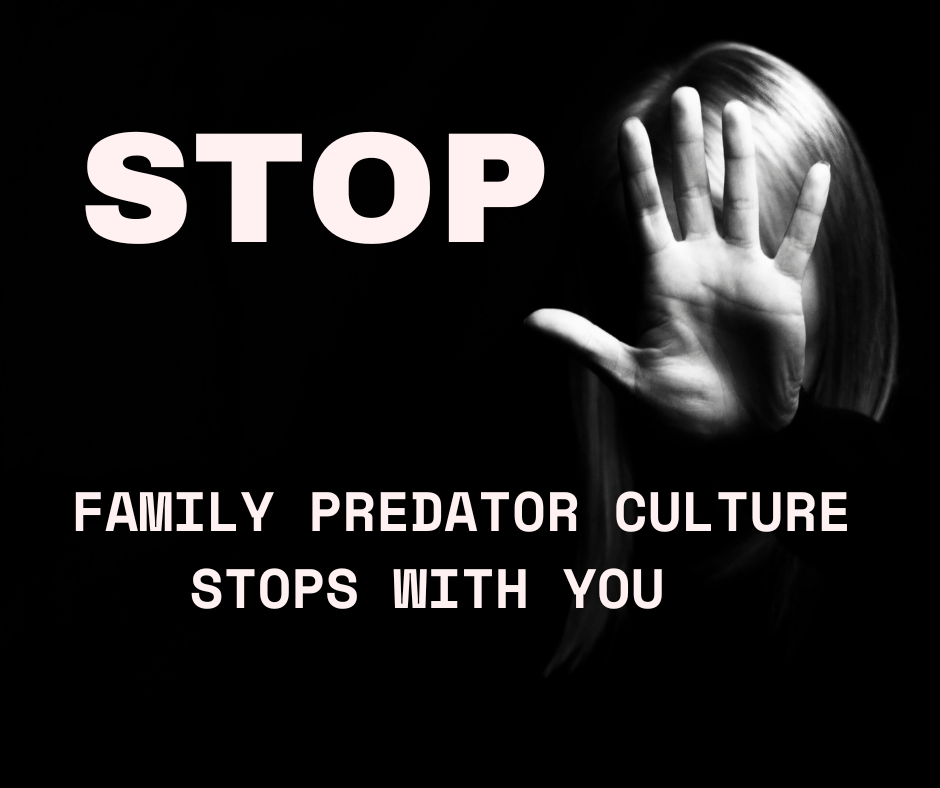
In part four of this series, Family Predators, I talked about why it is hard it is to walk away from family predator culture. However, I know quite a few people who have done it, including myself, and with my friends’ permission, I would like to share why and how we walked away.
For a lot of us having children was what pushed us to walk away. You can ask my kids how many family gatherings they have attended on either side of my family. They will tell you “not many”. For me, I was not risking my kids. A friend of mine told me after his oldest child was born, he and his wife never attended another family gathering because everyone knew you didn’t let Grandpa near the girls, not even the toddlers. Another friend said it simply, “I was still trying to find a way to forgive those people for letting my uncle molest me and my other boy cousins. There was no way I was taking my son into a group that I hated.”
All of us had the same experience: family members were angry. I was told, “Your parents have a right to show off your kids, and you have no right to stop them.” Um, I’m the mother who will not let my children grow up thinking family perversion is okay, and God gave me that right. Yes, there was pushback. Yes, I was the bad guy. No, I didn’t care. Other people I know have said the same thing.
While the details are different, we all had the same mindset: It won’t happen to my kids. And we didn’t let it.
Not everyone I know who walked away from the family predator culture has children, though.
One friend of mine said she would go to these family functions and then go home, watch movies, and drink a lot of wine, and one day she realized she only drank that much on days when she saw her family. She told me, “And that was it. I was done. I don’t date men who demean me. I don’t have girlfriends who treat other women with disrespect. Why in the world would I intentionally be around people who make me want to drink to feel better just because we share genetics? Nope. I never went to another family get together.”
As I said, the details are different, but all of us had a few things in common.
- We were all honest about what happened and how the family enabled it.
- We all called it what it was: sick and perverted.
- We all decided we were not going to be part of the sickness.
- All of us were able to see ourselves as individuals, not just members of the family.
In part 5, I talked about being angry and recognizing how people had not protected me and how something seemingly so small was a really big deal because it gave space for me as an individual who didn’t agree with the family mindset and didn’t follow the family rules. Everyone I know who has walked away from a family predator culture has had a moment when they were able to see themselves as an individual, not just a member of their family. When you are an individual, you give yourself permission to think and act differently, and you give yourself the right and power to say, “I am the place this crazy changes. It stops here.” And you walk away.
For me, I just stopped attending things and blamed living so far away because I didn’t want to deal with the fallout I knew would come from the confrontation. For me, I saw no point trying to pull family skeletons out of the closet knowing people would deny it or make excuses. It had already become a source for family jokes. I wasn’t going to waste my time on that.
For my friend with the son, his father never asked why he stopped attending family events, but his mother unleashed war in the family and in their community telling everyone how horrible he was and how much he hurt her for not letting her see her grandson. He said he never tried to engage. “When I was seven, I told her what was happening, and she slapped my face and told me never to talk about it again. So I didn’t. I just didn’t go any more.”
One friend of mine said her mother called to give her information about the family Christmas dinner, and she told her mother there would not be any more family gatherings for her. She said her mother was shocked and said everyone in the family was excited to see the baby, so she bluntly said, “I told you Uncle Bert would walk into the bathroom when I was in there and watch me go to the bathroom and then want to help me pull up my pants and always touched me, and you didn’t do anything.” Her mother said he was trying to be helpful and he couldn’t know someone was in there if the door wasn’t locked. I asked what she said. She said, “I told her a ten-year old does not need help with her pants, and no one ever put a lock on the door.” She shook her head and said, “I wouldn’t drink anything so I wouldn’t have to go pee, or I would hold it until we got home and then end up with UTIs. I just told her, ‘No. Uncle Bert will not touch Chloe. The family excuses stop here.’ And I never went to another family dinner, and I never felt like I was missing anything. If anything, I finally enjoyed the holidays.”
As I mentioned in part 2 of this series, one of the reasons I stopped attending gatherings as a young adult is because I hated how I felt. I hated the dread. I hated the game of avoiding my uncle. I hated how it felt when no one defended me. I just hated the whole experience, and I reached a point where I hated it more than I wanted to see the cousins I liked.
One of the things I allowed myself to do was look at the positives and negatives of family gatherings and the family in general. As I mentioned in part 4, part of the indoctrination is the loyalty to family. Loyalty to family means you show up, you protect the family, you honor the members. One day I realized I was expected to be loyal to the family, but they weren’t loyal to me. They didn’t show up for me. They didn’t tell my pervert uncle to stay home. They didn’t tell him to stop making sexual comments. No one protected me. No one honored me. Every time I attended a family function where that uncle was I felt anxiety, and I knew if he talked to me or touched me I would feel ashamed, disgusting, and powerless, but I was doing that because I was loyal to the family. One day I let it soak it that the negatives of trying to be part of family dinners and gatherings outweighed the positives, and that ended my family loyalty.
Different people stop the culture of family predators in different ways. Some are confrontational. Some simply stopped attending. Some pick and choose what they will attend. Some do it for themselves. Some do it for their kids. But every single one does it because they give themselves permission to see the sickness and to say, “That stops here.”
Jerri Kelley is a writer, mom, and culture changer. She doesn’t have a superhero suit, but if she did, it would include bright yellow sneakers.
 Jerri Kelley